What Are Naperville Braces and How Do They Straighten Your Smile?
You probably already know what braces look like: brackets on your teeth connected by wires. But here's what they actually do. They apply gentle, steady pressure that moves your teeth into the right positions over time. That consistent force is what makes braces one of the most effective orthodontic treatments available.
If you're considering braces in Naperville, Dr. Dwight Frey, an AAO member and recognized orthodontic expert, offers several treatment paths to fit your lifestyle and smile goals. Metal braces remain one of the most reliable options for correcting even complex alignment issues. For patients who want flexibility, our combined brackets and clear aligners approach lets you start with braces before transitioning to clear aligners, giving you the efficiency of brackets and the convenience of removable trays in one treatment.
What sets our Naperville practice apart is Dr. Frey's precision Bracket Positioning technique. This approach places each bracket at the exact angle and position needed for your unique tooth structure. The result? More accurate tooth movement and potentially shorter treatment time.
The Pitts 21 self-ligating braces we use at Frey Orthodontics feature a rectangular design inside the bracket that gives Dr. Frey greater control over tooth movement, so you can get a smile you can't wait to show off faster. If you've been putting off treatment because of how braces used to look and feel, modern options might surprise you.
We’re proud to offer the Pitts 21 braces system and ceramic braces to patients of all ages in Naperville, Algonquin, and the surrounding communities.
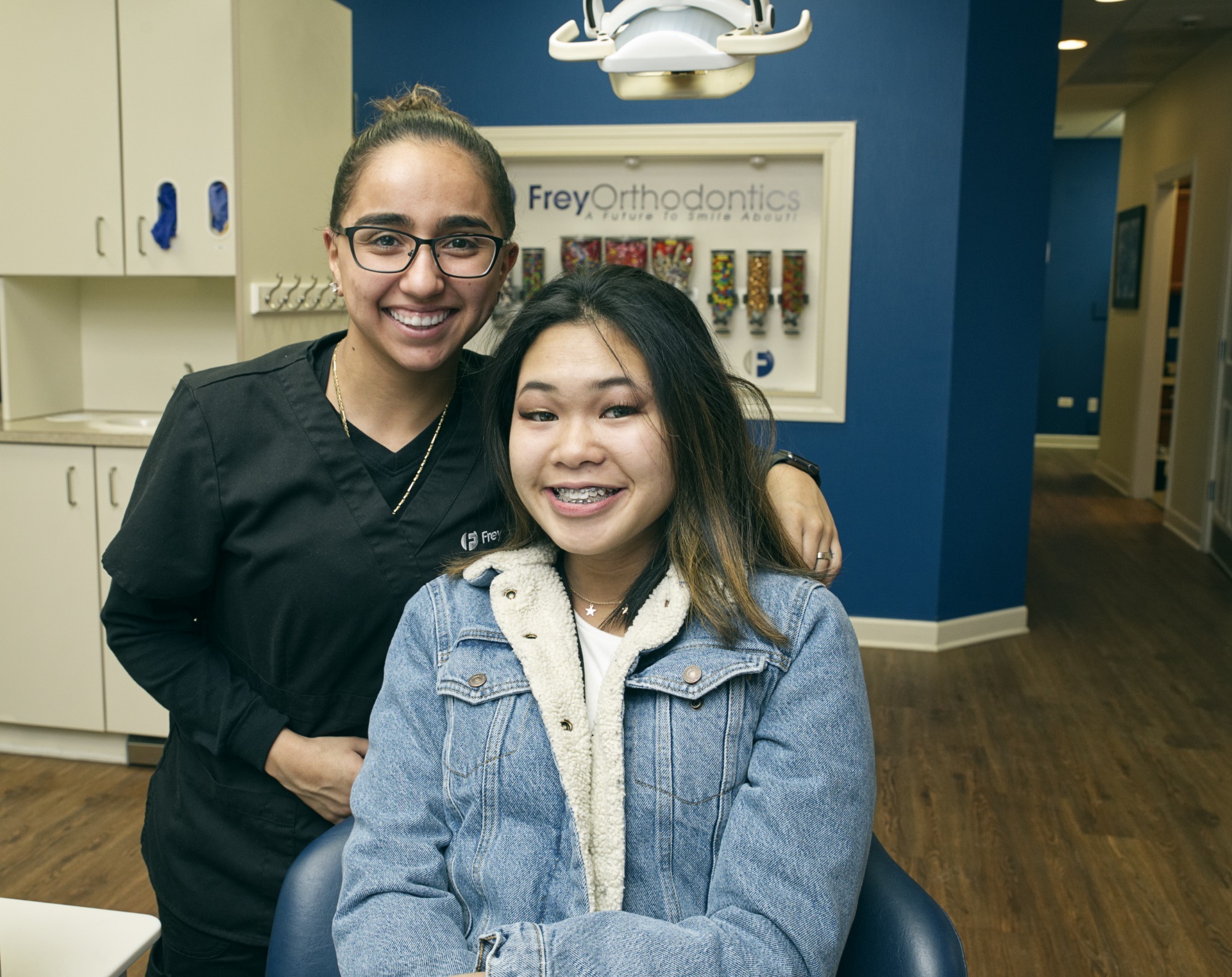
Naperville Braces: how the process works
Before braces are applied, our team will collect digital x-rays, photos, and a model of your mouth to ensure that your treatment plan is accurate and customized to your particular needs. Digital x-rays offer significantly less radiation, instant viewing, enhanced image quality, and the ability to quickly collaborate with your dentist when needed.
Once the records and any scans are complete, we’ll use this data to help formulate a treatment plan, which will include the movements each tooth needs to make to achieve optimal positioning. This will determine how Dr. Frey will place the brackets. For instance, if you have teeth that need to be tilted, the positioning of the brackets will be different than they would be for teeth that need to be turned.
Once the brackets are attached, the wire will be inserted to provide different types of pressure on different teeth. Bends in the wire will encourage specific and precise movements. This process of tooth movement is called remodeling, and involves minor changes in the bone that surrounds the roots of teeth. When pressure is put on the tooth, cells called osteoblasts and osteoclasts form around the tooth’s root. These components create a negative pressure on one side of the tooth, and bone is removed at this site. On the other side of the tooth, bone is reformed. This pressure and bone remodeling slowly moves the tooth into the correct position.
The important thing to remember about this process is that remodeling can only occur if constant pressure is put on the tooth. As the bone is absorbed on one side and then deposited on the other side, the tooth is able to move. Once the pressure stops, like when your braces are removed, the tooth will begin to settle into its new position. This also means that most teeth will start to naturally drift back towards their old positions over time. Fortunately, retainers will prevent this drifting and keep teeth in their new and improved positions as long as you wear them as directed by Dr. Frey!
Naperville Braces: what you can expect
Modern braces are better than ever! With the innovative Pitts 21 system, braces are self-ligated, meaning there’s no need for metal or elastic ties. Instead, specialized clips and slide mechanisms hold your wires in place, allowing for faster, more effective tooth movement. This system takes that a step further by using revolutionary square wire finishing, which results in significantly lighter forces, greater control, and enhanced comfort during treatment. Pitts 21 self-ligating braces require fewer total wires to complete your treatment, and it’s also the only system of its kind to provide 3D control throughout the treatment process. This gives us a more predictable treatment process and amazing results!
For patients who prefer a more subtle way of straightening their smile, ceramic braces can be an excellent option. These offer the same strength and reliability of traditional metal braces, but come with semi-translucent or tooth-colored ceramic brackets to blend in well with your natural smile. The brackets are about the same size and shape as metal braces, but much less noticeable, and when they are paired with clear, white, or tooth-colored wires and elastic ties, they’re an incredibly discrete treatment option. As you can imagine, ceramic braces are especially attractive to our adult patients!
All the braces we offer are extremely efficient at correcting oral issues, and often work faster at closing gaps and aligning teeth than other treatments might. This may shorten your overall treatment time. They also tend to be a cost-effective option for patients on a budget. The strength, durability, and affordability of traditional braces has made them the top treatment for orthodontic patients for years.
Naperville braces: how to care for your braces
Maintaining traditional braces can come with a bit of a learning curve, particularly in the early days, but with lots of patience and practice, you’ll have a good dental hygiene routine established in no time. Taking care of your teeth and gums while you’re in braces is as important as caring for the appliance itself, so you’ll need to be sure you’re brushing and flossing regularly. We recommend brushing at least twice a day, for at least two minutes each time. Brushing after all meals and snacks is even better if you can manage it!
Because braces create so many nooks and crannies, it becomes easy for food particles to get stuck, giving bad bacteria a place to grow and multiply. Flossing nightly helps keep tooth decay at bay, but it can be tricky with brackets, wires, and bands to contend with. Fortunately, there are a number of accessories available that can make oral hygiene easier for braces patients. Oral irrigators like a Waterpik use a pressurized stream of water to help rinse hard to reach places after flossing, and ortho-picks are an excellent way to floss effectively in braces.
Food restrictions are another learning curve when it comes to traditional braces. You’ll need to steer clear of anything too crunchy or too chewy in order to protect your brackets and wires while you’re undergoing orthodontic treatment. This includes several types of chips and candies, some raw veggies, popcorn, gum, and a handful of other items. Keep in mind that this part is only temporary, and it will all be well worth it when you see your new smile for the first time!
Naperville braces: follow-up appointments
Follow-up visits are an important part of your overall treatment process. We’ll schedule these for you at regular intervals throughout your treatment, usually about every 6-10 weeks. During these appointments, Dr. Frey may adjust the brackets, change the bands that are attached to the brackets, and replace the wire at this time as well. We do our best to keep these appointments short, so you can get back to work, home, or school as quickly as possible, and although you may experience some soreness following an adjustment, it should be minor and temporary. Don’t be tempted to skip any of these appointments! They help ensure you get the very best results in the least amount of time.
Who Is a Good Candidate for Braces in Naperville?
Braces help patients at nearly any age. Here's who benefits most from treatment at Frey Orthodontics.
Children (Age 7+) The American Association of Orthodontists recommends a first orthodontic evaluation by age seven. At this stage, Dr. Frey at Frey Orthodontics can spot developing issues with jaw growth and emerging teeth while some baby teeth are still present.
Early treatment may prevent more serious concerns later, and in some cases, it can shorten the time needed for braces down the road.
Teenagers With all permanent teeth in place, the teen years often offer the ideal window for full orthodontic treatment. Teens at Frey Orthodontics appreciate that today's self-ligating braces in Naperville are less noticeable and more comfortable than what their parents wore.
Adults More adults than ever are choosing braces to correct alignment issues they've lived with for years. Dr. Frey sees adult patients regularly at our Naperville practice, and many tell us they wish they'd started sooner. Braces for adults in Naperville are more common than you might think.
Complex Cases If you've been told your case is too complicated for clear aligners alone, braces or our combined brackets-and-aligners approach may be the answer.
Jaw-Related Concerns For patients with bite issues related to jaw positioning, Frey Orthodontics offers Facial Orthopedics to address certain jaw discrepancies that might otherwise require surgical intervention.